How a fresco is made, why it has to be finished before the plaster sets, and why the blue is the part that flakes
Fresco is the least forgiving way anybody has ever found to paint a wall. There is no going back over it the next morning, no reworking a face you are unhappy with, and no correcting a mistake except by cutting the plaster out and starting that patch again. Everything about the Scrovegni Chapel — how it looks, how fast it was painted, which parts have survived best — comes out of that constraint.
The chemistry, in four lines
Limestone is burnt in a kiln, which drives off carbon dioxide and leaves quicklime. Quicklime is slaked with water to make calcium hydroxide, which is the wet plaster. Pigment ground in water is brushed straight into that wet surface. And as the plaster dries it takes carbon dioxide back out of the air and becomes calcium carbonate again — effectively turning back into stone, with the colour inside it.
That is the whole trick and it is why a good fresco outlasts nearly everything else painted. The colour is not a layer on the wall. It is a constituent of the wall. The standard account puts it exactly: “the pigment is absorbed by the wet plaster; after a number of hours, the plaster dries in reaction to air: it is this chemical reaction which fixes the pigment particles in the plaster.”
The words that turn up on every chapel label
- Arriccio — the rough underlayer, spread over the whole area to be painted and left to dry for some days.
- Sinopia — the preparatory drawing made on the arriccio in red earth, which the finished painting covers and hides.
- Intonaco — the thin smooth final coat, laid fresh in patches, and the surface actually painted on.
- Giornata — literally a day’s work: one patch of intonaco, laid and finished between morning and evening.
- A secco — painting on dry plaster with a binder such as egg, glue or oil, for anything the wet method will not take.
Why the day is the unit, and what that means for this room
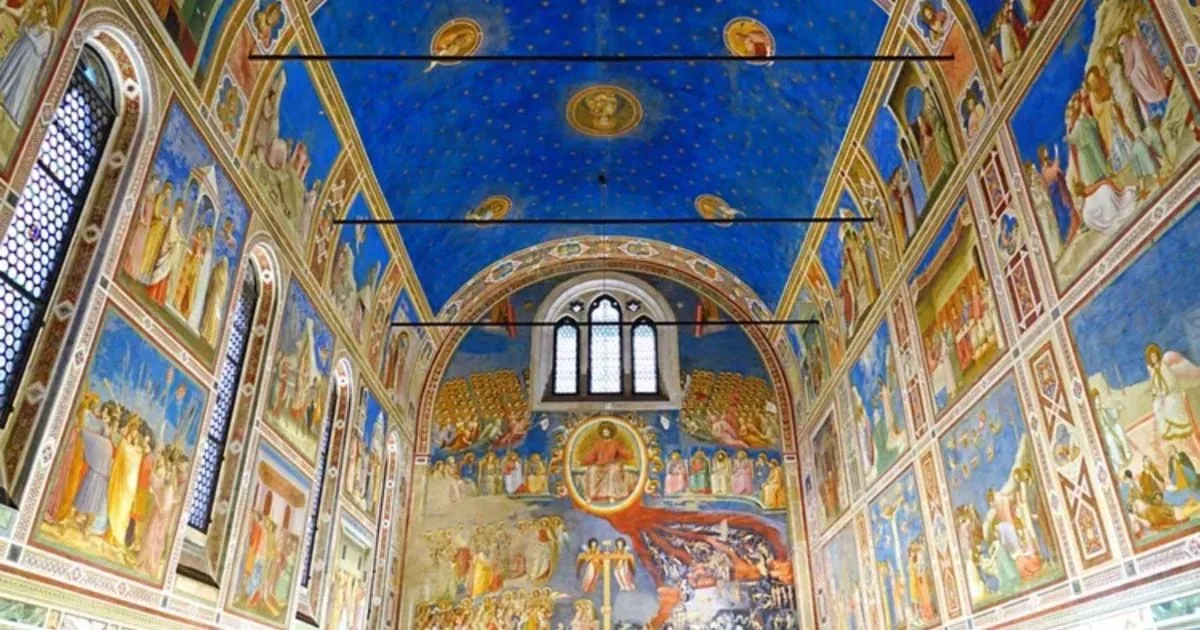
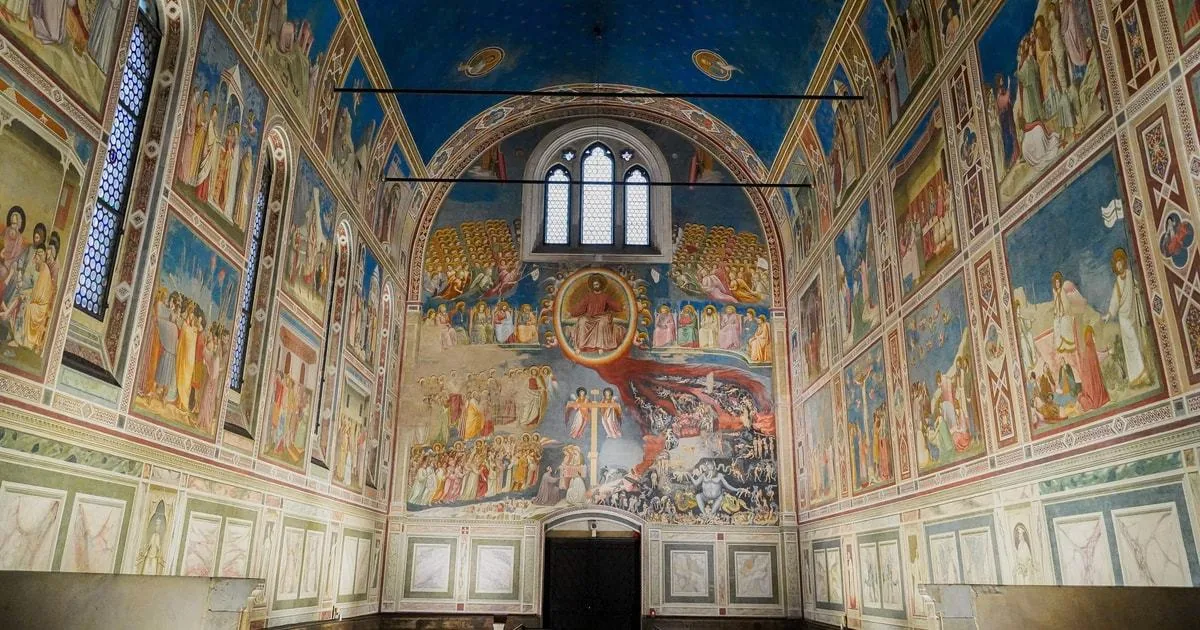
Lime plaster gives a painter something like a working day before it stops accepting pigment. So you do not plaster the wall; you plaster the piece of wall you can finish, and tomorrow you butt the next piece up against today’s edge. Those joins remain visible afterwards as faint seams, and reading them is how conservators reconstruct the order in which a cycle was painted — a head here, a robe and a background there, and you can see how a painter organised his week six hundred years later.
625 giornate were needed to paint this chapel. The campaign is dated 25 March 1303 to 25 March 1305, two years to the day, which is 730 days including everything — Sundays, winters, scaffolding moves, the days the plaster was too cold to take. A giornata is a patch, not a diary entry, so 625 of them is not quite 625 calendar days: more than one hand can be working at once. What it does measure is how much wet work the room swallowed. Set that beside the fifteen minutes of a visit and you have a sense of what you are looking at.
Why a secco flakes, and why it was used anyway
Some pigments cannot survive wet lime, which is alkaline and aggressive; others are too expensive to hand to a surface that absorbs whatever it is given. Both cases push a painter to wait until the plaster is dry and then paint on top in a binder. That works, and it looks the same on the day. It is simply not the same object: the colour is sitting on the wall rather than in it, held by egg or glue that will eventually let go. The plain statement of the difference is that buon fresco is more durable than any a secco work added on top of it.
So the pattern you see in any old fresco cycle — earths and lime whites still strong, blues and some greens thinned, patchy or lost — is not weathering. It is the history of which colours had to wait for the wall to dry (the pigment that had no alternative).
“What is the difference between a fresco and a mural?”
A mural is any painting made on a wall — that is the whole definition, and it says nothing about how. A fresco is a mural made by one specific method: pigment into wet lime plaster, fixed by the plaster setting. So every fresco is a mural and most murals are not frescoes. A wall painted in oils, in acrylic or in tempera on dry plaster is a mural and is not a fresco, however old it is and however much it looks like one.
The practical use of knowing this is that it tells you what you are looking at when a label says “fresco and a secco”, which is what most great cycles actually are: a fresco with the difficult colours added on top after it dried.
If you get close enough in the chapel, look for the faint seams between patches of plaster rather than for brushwork. They run round shapes rather than in straight lines, because the day’s patch was cut to the figure being painted that day.
 Most-reviewed
Guided Tour of Giotto's Scrovegni Chapel
 Sacred art of Padua
Padua: Scrovegni Chapel & Basilica with Sacred Art Guide
 After dark
Padua: Evening Tour with Admission to the Scrovegni Chapel
Related: the blue and why it went on dry, what is on the walls, the painter, and the fifteen minutes you get with all of it.
Frequently asked questions
What techniques did Giotto use?
Buon fresco: pigment ground in water and brushed into wet lime plaster, which fixes the colour as it sets by taking carbon dioxide back out of the air. Because the plaster only stays workable for about a day, the wall is painted in patches called giornate — 625 of them in this chapel — with the costly and lime-sensitive colours, above all the blue, added afterwards a secco.
What is the difference between a fresco and a mural?
A mural is any painting on a wall. A fresco is a mural made by one particular method: painting into wet lime plaster so that the pigment becomes part of the wall as it sets. Every fresco is a mural; most murals are not frescoes.
What is a giornata?
A day’s work: the patch of fresh plaster a painter lays and finishes in one session, because lime plaster stops accepting pigment once it sets. The joins between patches stay faintly visible afterwards, which is how the order of work can be reconstructed centuries later.
How long did it take Giotto to paint the Scrovegni Chapel?
The campaign is dated 25 March 1303 to 25 March 1305 — two years to the day, 730 days — and 625 giornate, or days’ work at the plaster, were needed to paint it. That is a fast, concentrated campaign for a scheme covering every surface of a building.
Why do frescoes lose their blue?
Because the blue usually was not painted in fresco. Wet plaster absorbs pigment, which is intolerable with a material as costly as ultramarine, so it went on a secco — onto dry plaster in a binder. Paint held by egg or glue on the surface is the paint that lifts over centuries, while the earths fixed inside the plaster stay. The pigment in question.