The Judgement on the wall behind you, and the man kneeling in it
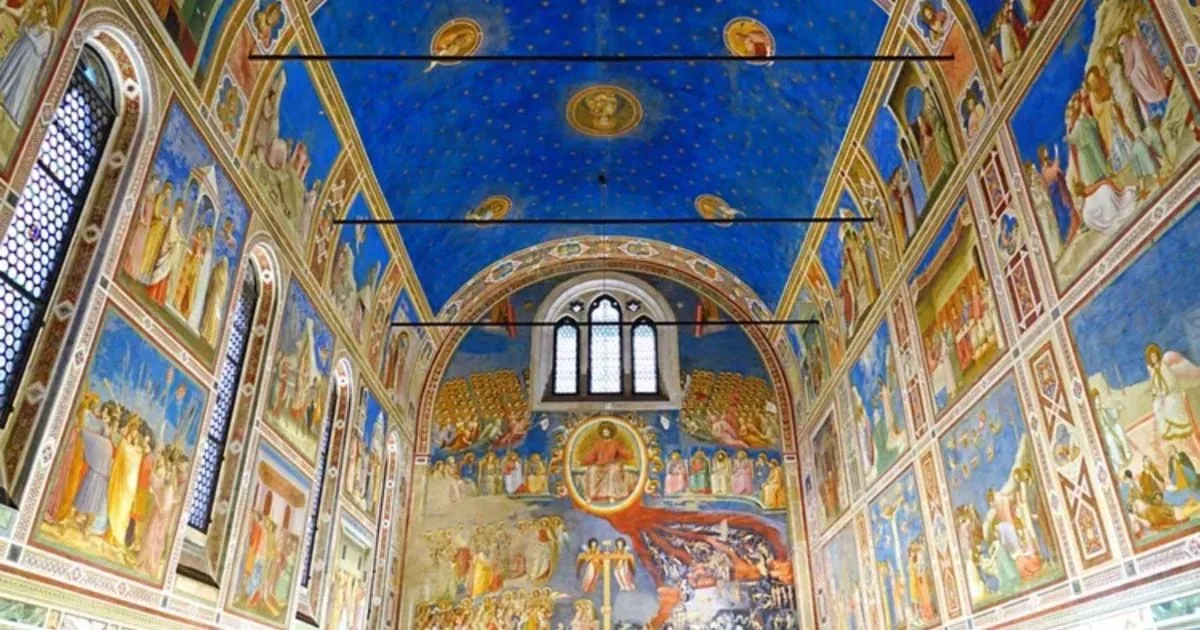
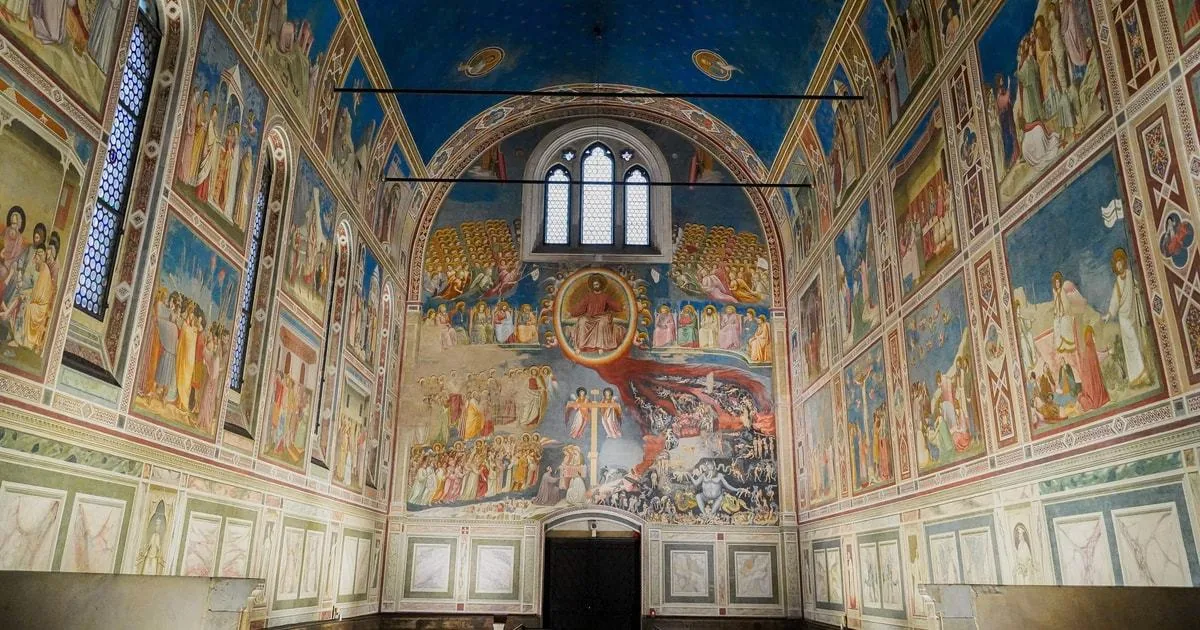
Every visitor walks into this chapel facing the altar, and everything about the room encourages you to keep facing that way: the vault runs towards it, the narrative starts at that end, the guide is standing there. The largest single painting in the building is behind you, and it is the last thing Giotto meant you to see.
Why it is on that wall
The room is a sequence, and sequences need an end. The narrative bands begin at the altar end with the Virgin’s parents, run round and down through her life, Christ’s life and the Passion, and arrive — chronologically and physically — at the wall you came in through. The Annunciation is over the chancel arch at one end; the end of time is at the other. Walking out of the chapel means walking towards the Judgement, and there is nothing accidental about that (the whole reading order).
It is also, in plain practical terms, the biggest thing in the room, because it gets the whole west wall instead of a band. That is why it survives so well in memory and so badly in visits: people see it for eleven seconds on the way out, over their shoulder, while somebody is holding a door.
The man in the bottom corner
Low on the wall, on the side of the blessed, a kneeling figure holds up a small model of a building. The building is this one. The man is Enrico degli Scrovegni, the Paduan money lender who commissioned the chapel, who was buried in it, and who died in 1336, the year before Giotto did.
It is worth being exact about what that image is and is not. It is a donor portrait, a completely conventional device: the man who paid presents his building to heaven, and is painted where the saved are. It is not evidence that the chapel was built as penance. That reading — that Enrico built it to atone for the usury of his father Reginaldo, whom Dante placed in the seventh circle of Hell — is a tradition, and historians dispute it. What the painting shows is a rich man commissioning the best painter alive and then taking his place in the picture on the correct side of the composition (the family, and both readings).
It is the most human thing in the building, precisely because it is so unashamed. Everything else in the room is the story of salvation. This one corner is a man making sure the record shows who paid — and it is on the wall behind you, which is why so many people leave without seeing it.
How to actually see it in the time you have
- Turn round early, not last. Look at it once when you come in, so you know the shape of it, then again properly at the end. Two looks beat one panicked one.
- Find the bottom corner on the blessed side first. The kneeling figure with the model is small, and it is the detail people are sorriest to have missed.
- Do not try to read the whole wall. It is a crowd scene the size of a house end. Take the structure — Christ at the centre, the saved on one side, the damned on the other — and one detail.
- Give it the last two minutes of the fifteen (how the quarter-hour goes).
If you are on a guided visit, ask your guide before you go in to point out the donor figure. Guides know exactly where it is; the fifteen minutes are too short to go hunting, and reviewers of four different listings say the guide is what made the time inside count.
Why English calls it the Last Judgment
Two languages, one subject. Italian usage here is Giudizio Universale, and the operator’s English pages render that as “Universal Judgement”, which is a straight translation and the term this site quotes. English-language art history mostly says Last Judgment. They are the same wall. If you search one and find the other, you have not found a second painting.
 Most-reviewed
Guided Tour of Giotto's Scrovegni Chapel
 Sacred art of Padua
Padua: Scrovegni Chapel & Basilica with Sacred Art Guide
 Capped at ten
Padua: Small-group walking tour with the Scrovegni Chapel
Around it: the three tiers that lead to this wall, who Enrico degli Scrovegni was, and the painter.
Frequently asked questions
What is on the entrance wall of the Scrovegni Chapel?
The Judgement, filling the whole wall opposite the altar. The operator’s own words are: “On the wall opposite the altar there is the grandiose Universal Judgement, which concludes the story of human salvation.” It is the end of the narrative that runs round the room in three tiers, and you see it on the way out.
Is Enrico Scrovegni in the Last Judgment?
Yes — low on the wall, on the side of the blessed, kneeling and offering a model of the chapel itself. It is a donor portrait: the man who paid for the building presenting it, painted among the saved. He died in 1336 and was buried in the chapel.
Did Enrico Scrovegni build the chapel to buy his way out of Hell?
That is a tradition rather than a documented fact, and historians dispute it. What is on record is that Dante placed his father Reginaldo in the seventh circle of Hell among the usurers, and that Enrico had himself painted into the Judgement on the side of the blessed. Both readings — penance, or a rich man’s private chapel — are argued. The family.
Why is it called the Universal Judgement and not the Last Judgment?
Because that is the operator’s English rendering of the Italian Giudizio Universale, and this site quotes the operator’s words as written. English-language art history generally says Last Judgment. They refer to the same wall.
How do I make sure I see it?
Turn round when you come in as well as when you leave, and ask a guide beforehand where the kneeling donor figure is. The wall is behind you for the whole visit, the visit is about fifteen minutes, and it is the single thing visitors most often walk out without properly looking at.