Why the Scrovegni Chapel is famous: one room, two years, and a sentence from UNESCO
A great many buildings in Italy contain fourteenth-century frescoes. What is rare here is not the paintings but the completeness: one commission, one painter, every surface, finished, in the order it was meant to be read, and still standing in the room it was made for.
What UNESCO actually inscribed, and why it is not just this chapel
People assume the World Heritage listing is the Scrovegni Chapel. It is not, quite. The property is called “Padua’s fourteenth-century fresco cycles”, and it comprises eight religious and secular building complexes across the city, with cycles painted between 1302 and 1397 by Giotto, Guariento di Arpo, Giusto de’ Menabuoi, Altichiero da Zevio, Jacopo Avanzi and Jacopo da Verona. Six painters, a century of work, one city.
Giotto’s chapel is the beginning of that sequence and the reason the rest of it exists: the citation says the cycle here is “considered to have marked the beginning of a revolutionary development in the history of mural painting”. If you have a day in Padua, the listing is a good itinerary in its own right — the other seven complexes are the argument that this was a city that could not stop painting for a hundred years (what else is walkable).
The three things that make one room famous
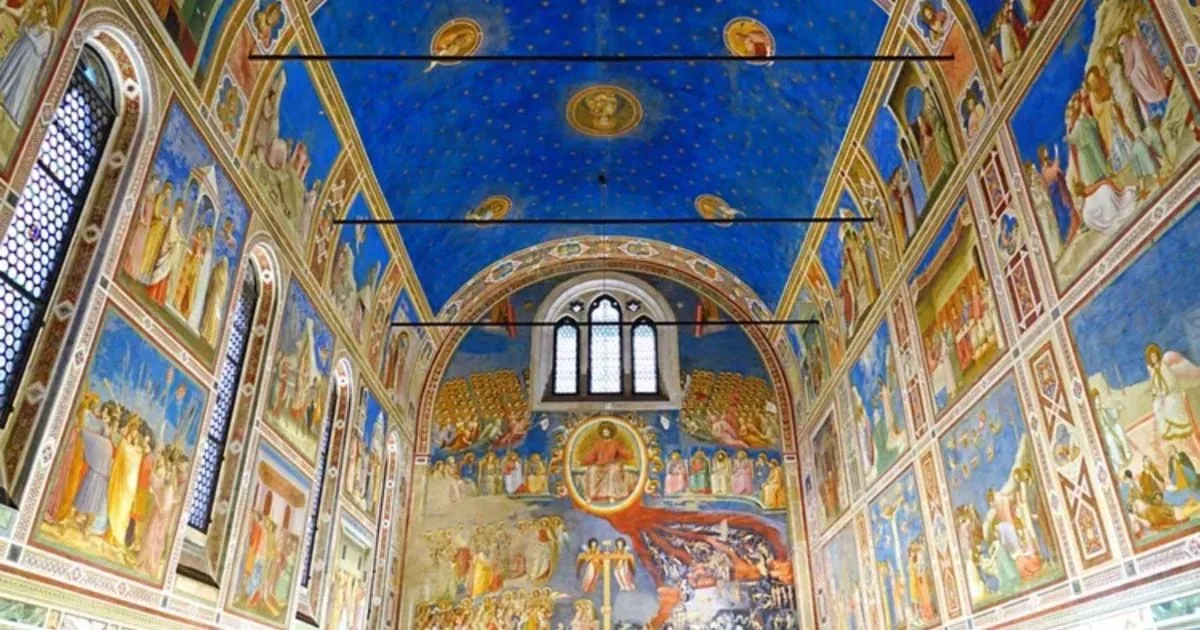
It is where you can see the change happen. Before this, figures in European wall painting sit in front of a gold or a pattern; after it, they stand in a space, with weight, casting the impression of occupying a volume, reacting to each other’s faces. The chapel is not the only place that shift is visible, but it is the place where it is visible all at once, in one programme, by one hand (Giotto, and what came after him).
It survives whole. Most medieval cycles reach us in pieces: a wall saved, a chapel rebuilt, a Baroque scheme over the top. Here the three tiers of narrative panels on both long walls, the barrel vault, the grisaille figures along the dado and the Judgement on the entrance wall are all one campaign (what is on each of them).
It was famous before it was old. Dante, who was alive while this was being painted, put Giotto’s name into the Purgatorio as the man who had taken the field from Cimabue. Two hundred and thirteen years after Giotto died, Vasari made him the hero of the opening of his Lives. This room has never had to be rediscovered.
“What is the most famous fresco in Italy?”
It is partly a matter of taste, but some things can be said. If what you mean is the single most reproduced image, this chapel supplies several of the candidates — the Lamentation, with the Virgin holding her son’s face, and the Kiss of Judas, where the two heads almost touch, are in every survey of Western art ever printed. If what you mean is the most complete surviving scheme by one painter in one room, then the claim for this chapel is strong and it is the claim this site makes.
And if what you mean is which fresco cycle changed what came after it, that is the question UNESCO answered in 2021, in a sentence about the beginning of a revolutionary development in the history of mural painting. It is worth noticing that UNESCO said that about mural painting generally, not about Italian painting or about this chapel alone.
The frescoes are famous; the chapel is not much to look at from outside. It is a plain brick box in a garden, with almost nothing on it. That is not a disappointment if you know it in advance — the whole of the money went inside.
What it is not famous for, and gets credited with anyway
- It is not a cathedral. It was a private chapel attached to a family palace, dedicated to St Mary of the Charity, built for one man’s use and his tomb (who Enrico degli Scrovegni was).
- It is not the Sistine Chapel. Different century, different city, different painter. The confusion is common enough that guides here hear it weekly.
- The scene count is not settled. You will find three different totals in three different books (why not, in full).
 Most-reviewed
Guided Tour of Giotto's Scrovegni Chapel
 Private, priced per head
Padua: Private City Walking Tour & Scrovegni's Chapel Visit
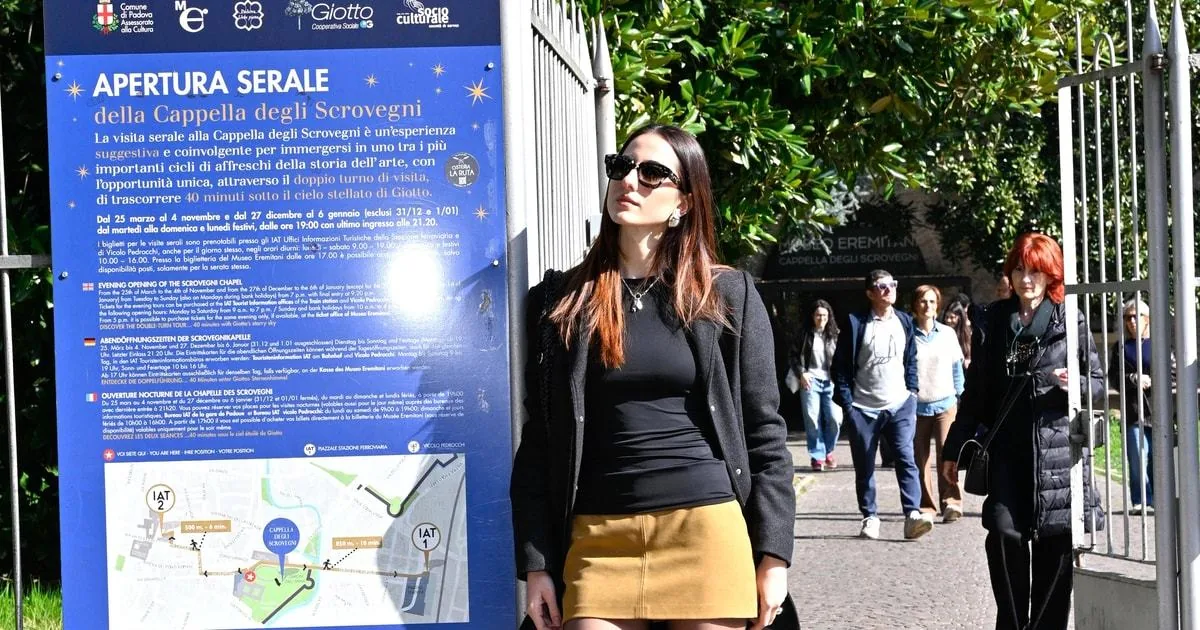 After dark
Padua: Evening Tour with Admission to the Scrovegni Chapel
Deeper: what is on the walls, who Giotto was, why it has two names, and whether it earns the journey.
Frequently asked questions
Why is the Scrovegni Chapel famous?
For one painter’s complete scheme surviving in one room. Giotto frescoed it between 1303 and 1305 for Enrico degli Scrovegni, and UNESCO’s citation for the property says the cycles “marked the beginning of a revolutionary development in the history of mural painting”. Almost nowhere else can you see a fourteenth-century programme entire, on every surface, in the order it was painted to be read.
What is the significance of the Scrovegni Chapel?
It is the point where European wall painting stops arranging figures on a surface and starts putting them in a space with weight and expression. That is what UNESCO meant by a revolutionary development in mural painting when it inscribed the property in 2021. What changed, specifically.
Is the Scrovegni Chapel a UNESCO World Heritage Site?
Yes, since 2021, as part of a property called “Padua’s fourteenth-century fresco cycles” — not on its own. The listing covers eight religious and secular building complexes in Padua, with cycles painted between 1302 and 1397 by Giotto, Guariento di Arpo, Giusto de’ Menabuoi, Altichiero da Zevio, Jacopo Avanzi and Jacopo da Verona.
What is the most famous fresco in Italy?
It is partly a matter of taste. What can be said is that this chapel supplies several of the most reproduced images in Western art, including the Lamentation and the Kiss of Judas, and that as a complete surviving scheme by one painter in one room its claim is unusually strong. What is actually on the walls.
Is the Scrovegni Chapel the same as the Sistine Chapel?
No. Different city, different century and a different painter: this is Padua, frescoed by Giotto between 1303 and 1305. The two are confused often enough that guides here hear it every week.